A year-end client gift should fit the business purpose, the recipient’s organization and the way the item will be handed over. Start with those decisions; then choose a product and presentation that can meet the approved plan.
1. Check whether a gift is appropriate
Before creating a list, check your company’s giving policy and the recipient organization’s rules. Some employers restrict gifts, especially during vendor selection, contract renewal or other decision periods. If the recipient is a public institution, university, regulated organization or procurement contact, get the required internal approval before offering anything.
Policies differ. Northwestern University, for example, tells its staff to refuse vendor gifts during a bid or contract renegotiation and gives separate rules for holiday gifts. That is an example of one institution’s policy, not a universal rule. The practical step is to ask the recipient’s authorized contact what is permitted—or choose a non-gift expression of thanks when the answer is uncertain.
Also decide whether the purpose is a general thank-you, recognition of a completed project or a seasonal greeting. Keep the message appropriate to the relationship and do not connect a gift to a pending business decision.
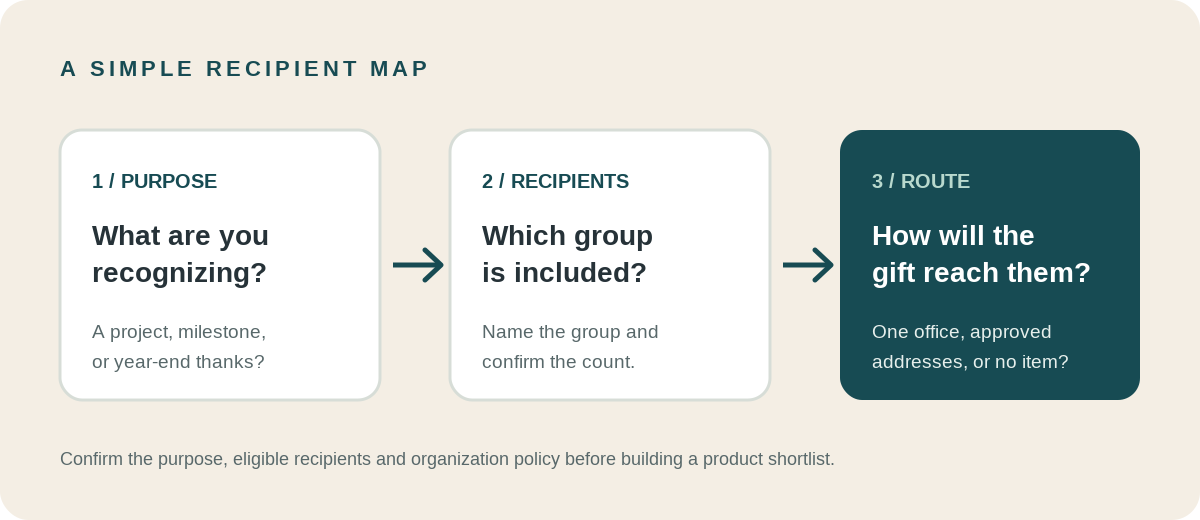
2. Build a recipient map before choosing items
Group recipients by the reason for the gesture and the way it will be handed over, not by assumptions about who deserves a more expensive item. A simple list might separate one client team, project contacts, regional offices or a broader partner group. For each group, record:
- the business reason for the gift;
- the internal owner who confirms the recipients and quantity;
- whether one shared gift or individual items make sense;
- the person who approves names, message and artwork;
- the expected handover route.
Check that the list is current. Staples’ holiday planning checklist recommends reviewing previous records, confirming names and addresses, and getting manager approval before selecting quantities. Treat that as a planning prompt, not as a production schedule or a requirement for every business.
3. Choose a gift direction that fits the group

For one office or client team, a shared item may be simpler to approve and distribute. For individual recipients, a compact useful item may be easier to carry or hand over. A coordinated set can work when there is a clear reason for each piece, but extra items add cost, packaging and approval decisions. Compare one well-chosen item with a set before assuming more is better.
Check practical fit: will the recipient group use it, can it be carried or stored, does it require sizes or personal customization, and will the logo and message remain clear at the intended scale? A neutral seasonal message may suit a mixed client list better than wording tied to a specific tradition; confirm preferences where they are known. Product directions can include drinkware, desk items, or bags, depending on the brief. Those are categories to explore, not guaranteed availability for every order.
Preparing year-end client gifts?Share the purpose, recipient groups, approximate quantities and preferred handover route. We can discuss suitable product directions for the brief.
Discuss a client gift brief →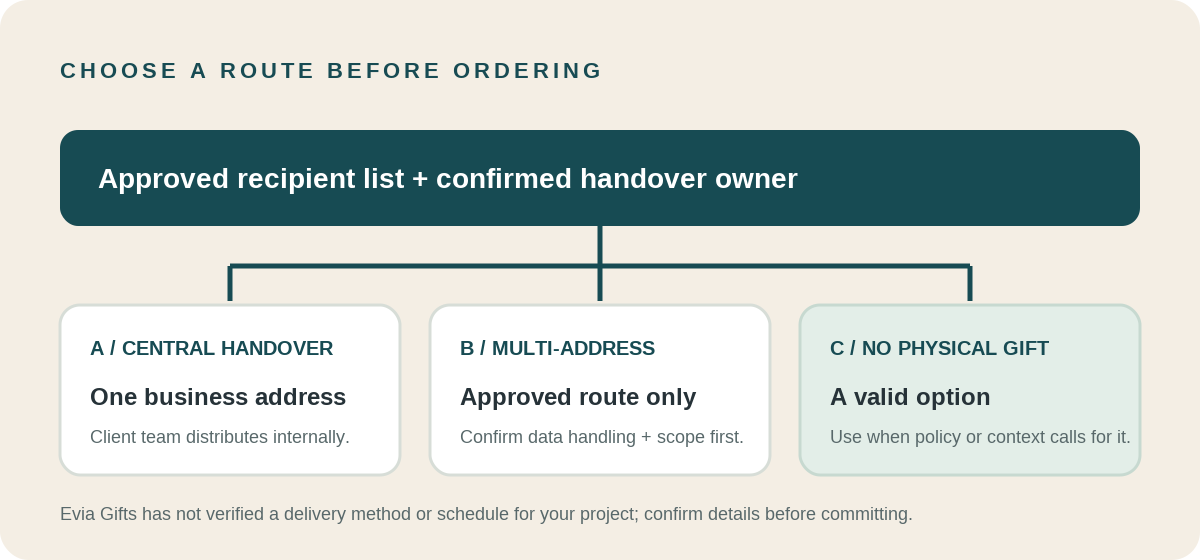
4. Decide the handover route before ordering
Choose among a central handover to the client’s office, individual destinations approved by the client, or no physical gift. The client may prefer to distribute items internally. For multiple destinations, confirm who is authorized to provide the addresses, which locations are in scope and how the list will be shared and retained.
Where GDPR applies, the European Commission describes data minimisation as limiting personal data to what is necessary for the purpose. Applicability and obligations vary by situation; as a practical starting point, collect only the details the approved route needs, keep the list within the organization’s authorized process, and do not put recipient addresses into a public inquiry form.
If the plan needs supplier-side delivery to multiple addresses, confirm whether that service, destination coverage, data transfer and timing are actually available before promising a date. A single shipment to the client’s approved business address may be a simpler alternative.
5. Confirm the list, message and artwork
Before production, assign one person to confirm the final recipient count and another to approve the final proof if those responsibilities are different. Check company and recipient names, any seasonal wording, logo versions, colors and personalization. For a co-branded item, confirm that each party has approved its mark and placement. Keep the approved version identifiable so an earlier draft is not mistaken for the final file.
Separate gift approval from the choice of delivery route. A recipient may allow an item but prefer that it be sent to an office, shared with a team or not sent at all. Record the decision according to your company’s own process.
6. Prepare a year-end client gift brief
- Purpose of the gesture and date it relates to
- Recipient groups, final quantity owner and any exclusions
- Recipient organization’s gift policy and internal approval status
- Budget range and whether to compare one item with a coordinated set
- Artwork, message, language, personalization and proof approver
- Central handover or client-approved multi-address route
- Packaging and presentation preferences
- Target in-hand date to verify against the selected item and route
For an onsite client gathering, see the client appreciation event gift guide, which focuses on guest groups and handover at the event. For broader employee and client product directions, visit Corporate & Employee Gifts.
Common questions
Should every client receive the same gift?
Not necessarily. A consistent gift can simplify approval and handover; different gifts may be appropriate when recipient groups or uses genuinely differ. First check policy, purpose and fairness, then decide whether variation is needed.
What if a recipient organization does not allow gifts?
Respect its policy. A note of thanks or another approved non-gift gesture may be more suitable. Do not ask an individual recipient to bypass their organization’s rules.
Can we send gifts to people’s home addresses?
Only if the recipient organization and your own approved process allow it, and the route is confirmed. Use the minimum recipient data needed and do not share personal addresses through an unapproved channel.
When should we finalize quantities?
Confirm the recipient list and quantity owner before requesting final product options. Production and delivery schedules vary by selected item and project, so verify timing before committing to a date.
Sources and scope
This guide uses Staples Business Advantage’s holiday checklist for list, spelling and approval prompts; Northwestern University’s gift FAQ as an example of recipient-specific restrictions; and the European Commission’s GDPR principles for the data-minimisation concept. Those examples do not replace the reader’s own company policy or applicable legal advice.
The two diagrams are original planning aids, not customer examples. Product availability, specifications, minimum quantities, samples, customization, costs, packaging and delivery arrangements must be confirmed for the selected project.
Plan a client gift around the relationship
Tell us the purpose, recipient groups, approximate quantity and how the gift should be handed over. We can review product directions against the details in your brief.