Start with the work participants will do, not a standard kit list. Some workshops need a physical prompt or material; others can use a shared file, a venue-only supply or no kit at all. Make a separate plan for onsite, remote and digital participation, and check that no one needs an item simply to access the core activity.
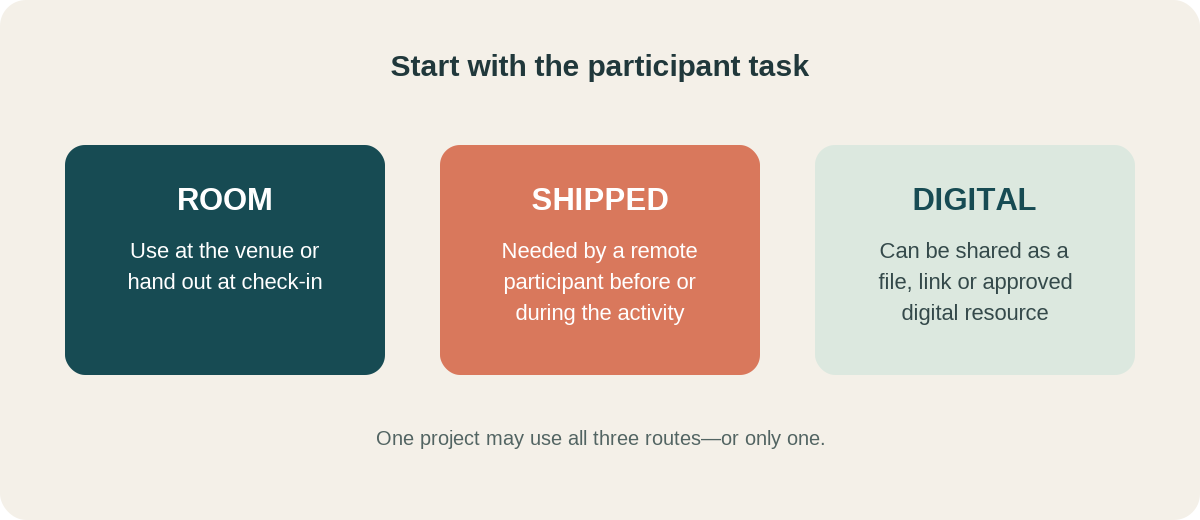
1. Define the task the workshop asks people to do
Describe the activity in plain terms: annotate a printed map, assemble a sample, write ideas on cards, compare objects, or discuss a shared document. Then mark what is essential to participation and what simply adds atmosphere.
IEEE’s hybrid event guide treats in-person, live online, non-live online and multiple-site formats as distinct planning options. For a kit, that suggests a useful first question: what does each participant need to take part in this particular exercise? The event organizer should decide the format and participation requirements.
2. Sort each item by its role

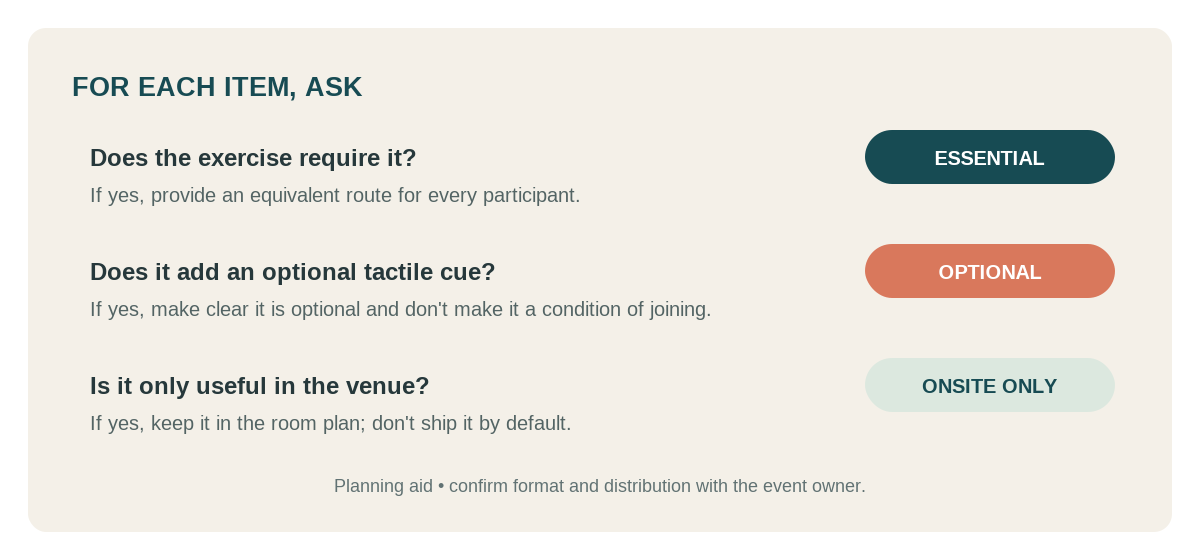
Use three groups to keep the list manageable:
- Essential to the exercise: participants need it to complete a shared task. If the item is physical, decide how remote participants can receive an equivalent or suitable alternative.
- Optional tactile cue: the item may make the activity more tangible, but the exercise still works without it. Say that clearly and avoid making the item a condition of joining.
- Venue-only supply: the item supports room setup, display or onsite facilitation. Keep it on the room list unless there is a reason to send it elsewhere.
Ask the facilitator to confirm the categories. A procurement list should not decide which participants can engage in the workshop.
3. Choose a route for each participant group
Build a simple table with one row per item and columns for purpose, audience, route, owner and final check. For example, a printed exercise sheet may be shared as an approved digital file with remote participants; a table marker may remain in the room; a welcome note may be included only if the organizer wants one.
Do not assume that a remote participant needs a physical parcel. Zoho’s hybrid-event guide discusses virtual event kits as one possible way to give remote attendees tangible materials, alongside other inclusion and participation considerations. It is an option to evaluate for a specific activity, not a rule that every hybrid workshop needs a shipped kit.
Planning a hybrid workshop?Share the activity, audience mix and which items are essential. We can discuss a product direction for the routes your team has chosen.
Discuss a workshop brief →4. Plan remote handovers with the organizer
Before discussing a parcel, have the event owner confirm the destination plan, countries or regions involved, who is permitted to handle participant details, and the date by which materials must be available. The organizer should use its own approved process for collecting addresses and sharing only the information needed for fulfillment.
Keep uncertain delivery regions, customs treatment, costs and timing as items to confirm for the selected project. Evia Gifts does not promise a particular global delivery route or collect participant addresses through this guide.
Also confirm whether remote materials need to arrive before the activity and whether the same content will be available digitally if a shipment is delayed or not appropriate. The facilitator should approve any alternative.
5. Prepare a hybrid workshop kit brief
- Workshop purpose, date, time zones and participation format
- Participant groups and approximate counts for each route
- Activity steps and which materials are essential, optional or onsite-only
- What can be shared digitally and who approves the file
- Destination and address-handling process, managed by the organizer
- Artwork, languages, packaging preferences and approval owner
- Target arrival date and any fallback if an item is not suitable to ship
Start with the exercise and route matrix; then review relevant office and workshop items or bags. For a general event welcome bag rather than collaborative workshop materials, see the conference attendee welcome-bag guide. Product availability and project details are confirmed for the selected brief.
6. Common questions
Does every remote participant need a mailed kit?
No. First decide whether a physical item is needed for the activity. A digital file, venue-only supply or no kit may fit better.
How should onsite and remote kits differ?
Keep the task and essential information consistent, then vary the format where the participant route requires it. The facilitator should approve any alternative to a physical exercise material.
Who should provide remote participant addresses?
The event organizer should manage participant data through its approved process and confirm which details may be shared for the project.
Sources and scope
This guide draws on the format and participation planning in IEEE’s Going Hybrid guide and treats virtual kits as an optional format mentioned in Zoho Backstage’s hybrid-event guide. Zoho’s platform, equipment lists, statistics and service claims are not presented as Evia Gifts facts.
The route diagram and item map are original planning aids. Product availability, artwork, samples, packaging, cost and delivery details require project-level confirmation.
Plan materials around your hybrid workshop
Tell us the activity, participant routes and which materials your facilitator has approved. We can discuss suitable product directions for your brief.